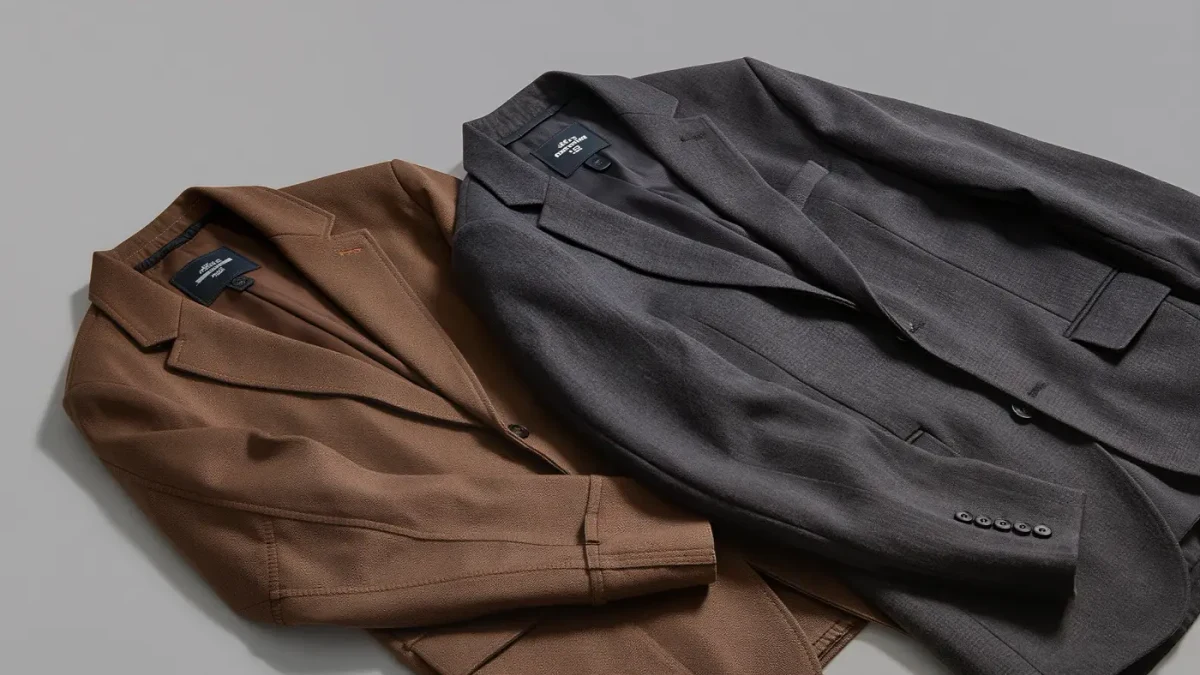
Carhartt WIP and sacai confirmed another joint collection in early February 2026, per the labels' launch coverage, continuing a collaboration pattern in which a Japanese design house re-cuts American workwear blocks into hybrid garments. The drop follows the two labels' earlier joint ranges and arrives in a season crowded with workwear pairings, from Carhartt's own archive reissues to heritage outerwear licenses. The question the collection raises is the one every workwear collab now faces: what, exactly, is being changed — and what is contractually protected from change.
Why do design houses keep borrowing workwear blocks?
Because the blocks are the value. A workwear pattern carries decades of fit corrections for movement — deep armholes, reinforced stress points, utility pockets placed for actual tasks — that a design studio would need years to redevelop. A collaboration rents that engineering for one season. The workwear partner supplies the canon; the design partner supplies the silhouette disruption, typically through panel splicing and proportion shifts that sacai has made its signature. Neither party touches what makes the garment work, because that is the thing being licensed.
What does the collaboration change in production?
More than the marketing suggests. Per the labels' prior joint releases, hybrid garments are cut from both partners' cloths in the same garment — workwear duck or denim alongside suiting-weight wools — which forces the factory to reconcile fabrics with different shrinkage and handling on one cutting table. That is a genuinely harder production problem than either label's standard line, and it is where collab garments most often differ from their precedents in durability. A spliced jacket whose wool panel shrinks at a different rate than its canvas body is a fit failure the original never faced.
Related stories: Carhartt WIP Opened 2026 With a Japan-Only Denim Capsule · Uniqlo's July Lounge Drop Tested the Post-Volume Basics Formula.
How does the February collection compare with its predecessors?
Per the pattern the two labels set in earlier joint ranges, the 2026 collection repeats the splicing method — bodices halved, sleeves rotated, hemlines offset — while the workwear partner's hardware, stitching density and pocket construction carry through untouched. Per the launch coverage, the range again spans jackets and layered separates rather than a single statement piece, which signals a licensing-scale production run, not a runway capsule. The repeatable structure is the news: a third joint collection confirms this is a program, not an experiment, and programs are measured by whether the factory QC holds across three seasons of increasingly complex splices.
Is the workwear collab market saturated?
The calendar says yes. February 2026 alone carried Carhartt WIP x sacai, a Barbour x Farm Rio pairing, and continuing workwear-adjacent launches from license-driven brands, per trade roundups of 2026 collaborations. The volume matters for a specific reason: each pairing dilutes the signaling value of the previous one, pushing partners toward rarer archive pieces. The predictable next move, which prior collab cycles already show, is collaboration on the icon itself — the jacket or bib overall — rather than on the periphery pieces current pairings favor.
What should a buyer of the collection check first?
The composition label, not the lookbook. The durable question for any workwear hybrid is what fraction of the garment is task-rated cloth and what fraction is runway cloth, because that ratio predicts how the garment ages. Per the care-label rules that govern every garment sold in the United States, the fiber content is the one specification a collab cannot quietly blur — and it is printed where nobody styles it.